Background and Motivation
Separated turbulent flows, especially in situations of incipient separation at the edge of the operational domain, remain one of the major challenges in aerospace aerodynamics. The current industrial standard based on the Reynolds-Averaged Navier–Stokes (RANS) approach offers an attractive balance between accuracy and computational cost but has a limited fidelity in separated turbulent flows.
As a result, scale-resolving simulation techniques are required to achieve the predictive accuracy needed for advanced aerodynamic applications. Among these methods, hybrid RANS/LES approaches are widely regarded as the most promising solution from an industrial perspective, as they combine the robustness and efficiency of RANS with the improved flow-physics representation of Large Eddy Simulation (LES).
Objectives of AD/AG-61
The AD/AG-61 Action Group will investigate the application of RANS/LES methodologies where LES is performed inside attached boundary layers while the near-wall inner region will continue to be modelled using RANS techniques. This is in contrast with traditional RANS/LES methods treating the complete attached boundary layers using RANS and offers a higher fidelity in the representation of turbulence.
This work builds upon experience and knowledge acquired through several European research projects, as well as previous GARTEUR Action Groups AD/AG-49 and AD/AG-54.
Validation and Verification Test Cases
To support the development, verification and validation of Wall-Modelled Large Eddy Simulation (WMLES) and Embedded LES methodologies, the following benchmark cases will be considered:
- Mixing co-flow of a wake and a boundary layer
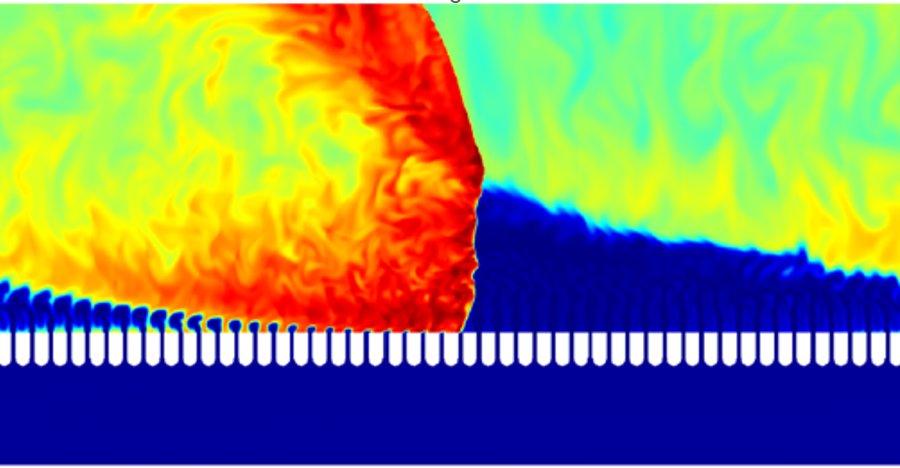
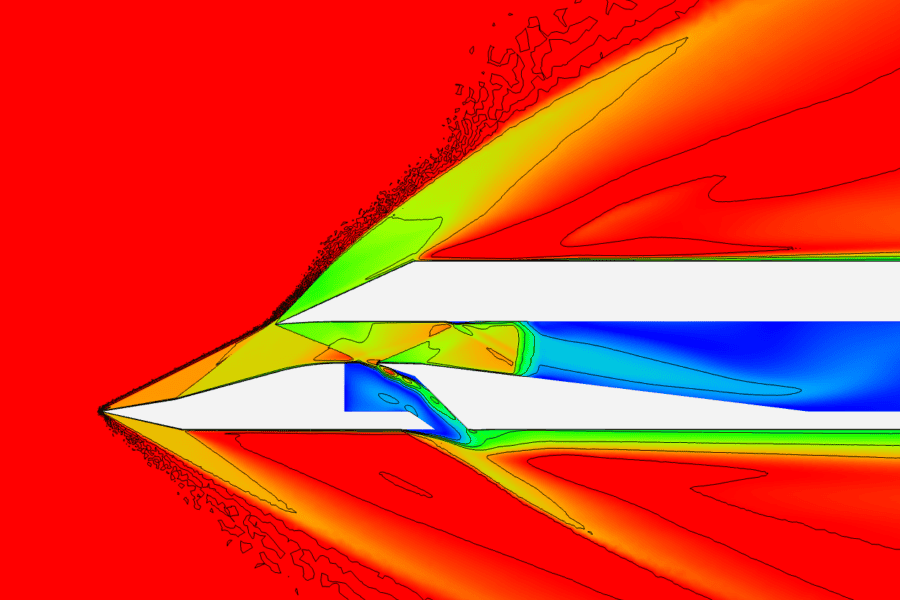
- Shock-wave/boundary-layer interaction (SWBLI)
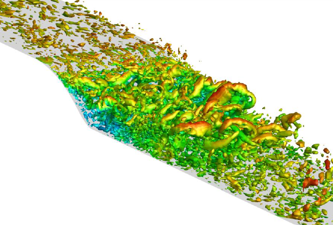
- Shallow flow separation from a smooth surface
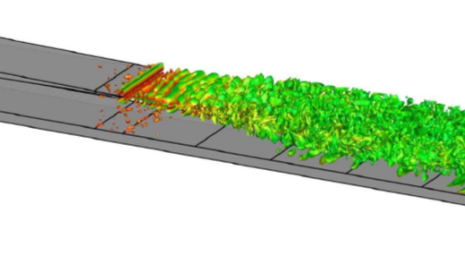
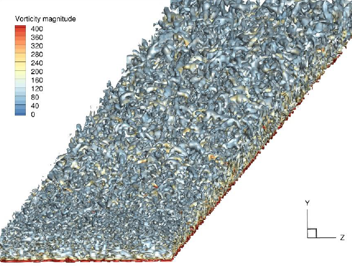
- Fundamental WMLES benchmark: zero-pressure-gradient (ZPG) flat-plate boundary layer
These test cases have been selected to provide a progressive assessment of modelling capabilities across a range of flow phenomena relevant to aerospace applications.
Chair: Nicolas Renard, ONERA
Co-Chair: Saleh Rezaeiravesh, University of Manchester
Monitoring responsable: Jean-Luc Hantrais-Gervois, ONERA